


Education Hub ~ Tics

Tics and Tourette Syndrome
What is a Tic?
A tic is a sudden, rapid, repeating movement or sound that a person cannot control.
Motor Tics (Movement)
Examples:
Blinking or eye rolling
Facial movements or grimacing
Shoulder shrugging
Arm, leg, or head jerking
Touching or tapping objects
Vocal Tics (Sounds or Words)
Examples:
Throat clearing / coughing
Sniffing or clicking noises
Whistling
Words, phrases, or sounds (including animal sounds)
Mental (Cognitive) Tics
Some people experience thoughts that repeat on a loop.
These are just as real and can be just as challenging.
Premonitory Urges
Many describe a rising internal sensation before the tic happens.
Some find the urge more uncomfortable than the tic itself.
Why Tourette’s Is Often Misunderstood
For many years, media has focused mainly on coprolalia (swearing tics).
However, only around 10–15% of people with Tourette Syndrome experience this.
Most people with TS have:
Subtle tics
Internal sensations others cannot see
Fluctuations in symptoms depending on stress, tiredness, or environment
Because many tics can be small or easily masked, Tourette’s can often be invisible.
Even when tics are not obvious, individuals may still experience:
Muscle pain or fatigue
Throat soreness
Headaches
Embarrassment or anxiety
Low self-confidence or shame
This is why education matters — so that understanding can replace misunderstanding.
Here’s the truth:
No one has the right to question your diagnosis, your child’s diagnosis, or the way Tourette’s presents for you.
Tourette Syndrome exists on a spectrum, and no two people experience tics the same way.
Diagnosing Tourette Syndrome
Tourette Syndrome (TS) is a neurological condition that affects how the brain controls movement and sounds. For many people, Tourette’s is misunderstood because of how it has been portrayed in television, films, and social media. This can lead to confusion, assumptions, and unfortunately, people feeling that they need to prove their diagnosis.
How Tourette’s Is Diagnosed
A diagnosis is based on:
Having both motor and vocal tics
Present for more than 1 year
Starting in childhood
Tourette Syndrome is usually diagnosed by:
A Paediatrician
Neurologist
Child & Adolescent Mental Health Service (CAMHS)
Specialist in tic disorders
There is no scan or blood test for TS — diagnosis is clinical and based on symptoms.

Why Getting the Right Diagnosis Matters
Not all tics are Tourette’s. Tics can also appear due to:
- Anxiety and emotional stress
- Autism or ADHD
- Functional Neurological Disorder (FND)
- PANDAS/PANS (immune-related onset)
- Trauma
- Certain medications
Because these causes require different support, the correct diagnosis helps ensure:
- The right treatment
- The right strategies
- And reduced symptoms, rather than increased ones
Sometimes, a person may have both Tourette’s and another condition that affects tics, so it’s not about labels, but about getting the full picture.
Other
Tic
Disorders
Tourette Syndrome
Motor and vocal tics for more than 1 year.
Chronic (Persistent) Tic Disorder - Motor or vocal tics (only one type), lasting longer than 1 year.
Provisional (Transient) Tic Disorder
Tics lasting less than 1 year, usually in childhood.
Tics are often described as the tip of the iceberg because many individuals also experience features of other conditions, such as anxiety, sensory differences, ADHD, OCD traits, or emotional regulation challenges.
You Are
Not
Alone
Tourette Syndrome may look different from person to person, but every experience is real, and every experience matters.
If you would like support with:
Understanding diagnosis
Managing tics and urges
Reducing anxiety
Educating school, family, or workplace
Or supporting your child with confidence
I’m here to help.
Together, we move forward with knowledge, compassion, and empowerment.
Educating Your Circle
One of the most powerful forms of support is helping the people around you understand:
- What Tourette’s is
- How it affects you (or your child)
- What responses feel supportive
This doesn’t mean explaining yourself to everyone — but sharing with the people who matter most can reduce anxiety, build confidence, and create safer emotional space.
You do not need to pretend your tics do not exist.
You do not need to hide to make others comfortable.
Understanding grows when we are able to be seen.

Functional Tics
Having Functional Tics for longer than a year does not mean they “become” Tourette’s.
What are functional tics?
Functional Tics are part of a condition called Functional Neurological Disorder (FND).
FND affects how the brain sends and receives signals in the body.
There is no damage to the brain structure
The brain itself is healthy
But the communication system (the “mind-body software”) becomes overwhelmed or stuck in a loop.
A useful way to understand this is:
If the brain is the computer:
The hardware is healthy
But the software program is glitching or overloaded
This means the symptoms are very real, even though they are not caused by a traditional neurological condition.
Functional Tics vs Tourette
Functional Tics can look very similar to tics seen in conditions such as Tourette Syndrome but the cause is different.
It is also possible for someone to have both genetic tics and Functional Tics, which is very common and does not mean anything is “wrong” with you. It simply means your brain and nervous system are responding to something in a different way.
Functional Tics often begin in:
Teenage years or young adulthood
And are more common in girls and people assigned female at birth
However, anyone can develop them at any age.
What Functional Tics Can Look Like
Functional Tics can involve:
-
Large or dramatic movements
-
Sudden full-body jerks
-
Repetitive postures or gestures
-
Complex, longer, or “performative” movements
-
Loud vocalisations or repeated phrases
They often:
-
Begin suddenly
-
Develop quickly into more complex patterns
-
Are more noticeable in stressful, stimulating, or social environments
-
May reduce when a person feels safe, calm, or focused on something absorbing
Other Symptoms That May Occur Alongside Functional Tics
Not everyone experiences these but some people may also have:
-
Fatigue or lack of energy
-
Chronic pain or headaches
-
Anxiety or panic
-
Mood changes or emotional overwhelm
-
Dissociation or “checking out”
-
IBS or stomach discomfort
-
Functional seizures (non-epileptic seizures)
-
Limb weakness or numbness
-
Sensory overload
Again, these symptoms are real.
They are not deliberate, attention-seeking, or behavioural.
Why Do Functional Tics Happen?
There is no single cause, but common contributing factors include:
Stress overload or emotional pressure
Significant life change or disruption
Trauma (recent or past)
Anxiety or chronic worry
Burnout or exhaustion
Masking neurodivergence (e.g., ADHD or Autism)
Sensory overwhelm
Identity or social pressures
Learned physical patterns reinforced by the brain
Functional Tics are the body’s way of sounding an alarm when the nervous system is overloaded.
The tic is not the problem.
The tic is the signal that something deeper needs space and support.
Diagnosis
Diagnosis is usually made by:
Neurology
Paediatric specialists
Psychologists or therapists experienced in FND
Sometimes a multidisciplinary team
A helpful assessment looks at:
Symptom history
Suddenness of onset
Patterns of stress and nervous system overload
Family and developmental timeline
Differentiation from genetic tic disorders like Tourette’s
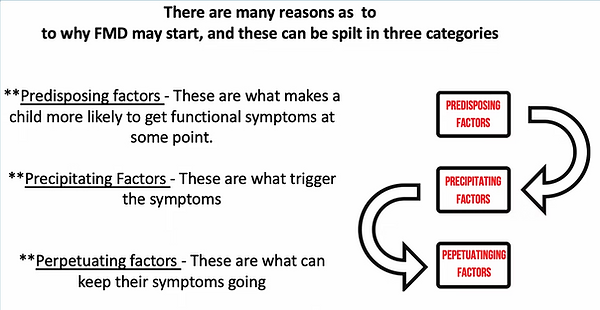

How Functional Tics Differ from Tourette’s


PANS/ PANDAS
What Is PANDAS?
PANDAS stands for:
Paediatric Autoimmune Neuropsychiatric Disorders Associated with Streptococcal infections.
This condition occurs when the body responds to a Group A Strep (GAS) infection (such as strep throat, scarlet fever, or sometimes impetigo).
In some children, the immune response mistakenly affects an area of the brain involved in movement, behaviour, and emotional regulation (the basal ganglia).
Typical Characteristics
Sudden and dramatic onset (often literally overnight)
Symptoms may appear after: Strep throat Tonsillitis Scarlet fever Skin infections caused by strep
Common Symptoms
-
New or suddenly worsening tics
-
Obsessive-compulsive behaviours or intrusive thoughts
-
Eating changes (including fear of swallowing or loss of appetite)
-
Sleep difficulties
-
Behavioural regression (acting younger than their age)
-
Sudden anxiety, clinginess, or separation fears
-
Irritability or emotional outbursts
-
Handwriting deterioration or decline in school performance
-
Increased urination or urinary accidents
Child may appear overwhelmed, “frozen,” or emotionally “stuck”
Children often describe feeling trapped inside their own body, which can be very distressing.
What Is PANS?
PANS stands for:
Paediatric Acute-onset Neuropsychiatric Syndrome.
PANS has a similar rapid onset, but it is not limited to strep.
It can be triggered by:
Other infections (viral, bacterial, sinus infections)
Inflammation
Autoimmune response
Environmental stress
Metabolic factors
Key Features
A child may be diagnosed with PANS when:
-
There is a sudden onset of OCD or severe eating restriction
AND
At least two of the following symptoms also appear:
-
Anxiety - Especially separation anxiety
-
Mood changes - Emotional swings, sadness, depression
-
Irritability or aggression - Arguments, meltdowns, frustration
-
School decline - Memory issues, loss of skills, difficulty focusing
-
Motor or sensory changes - Tics, sensory overload, handwriting changes
-
Sleep difficulties - Insomnia or very disrupted sleep
-
Urination changes - Bedwetting or frequent urination
If strep is the trigger, a child may meet criteria for both PANS and PANDAS.
Diagnosis
Diagnosis is usually made by:
Paediatrics
Neurology
Immunology or Rheumatology
Specialist services familiar with PANS/PANDAS
There is no single test, so clinicians look at:
Medical history
Infection history
Physical exam
Behavioural and emotional changes
Blood tests (sometimes) to look for inflammation or recent infection
The most important feature is the sudden change.
Treatment and Support
Treatment often includes a combination of:
Medical management (to treat underlying infection or inflammation)
Therapy and emotional support to manage anxiety, OCD, or behaviour changes
School support strategies
Gentle family guidance for stress reduction and coping
With the right support, many children experience significant improvement.